
The Governance Gap Nobody Talks About: Regulation 17 and the Hidden Risk in Care Home Ear Health Provision
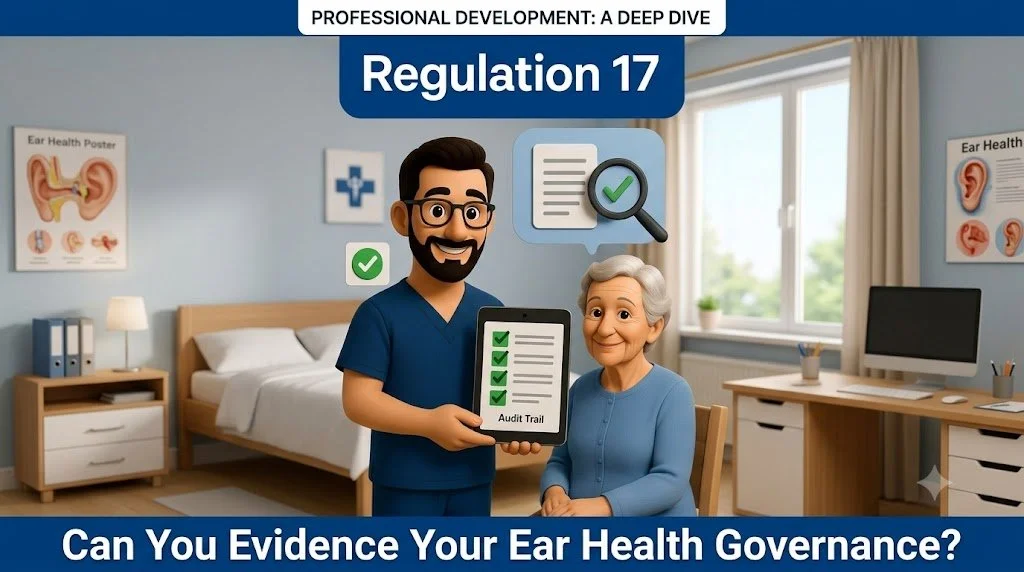
A clinician with a tablet showing "Audit Trail" and an elderly resident alongside in a care home, showing ear anatomy posters visible in the background
The foundation of everything the CQC expects is good governance.
It is Regulation 17 of the Health and Social Care Act 2008 (Regulated Activities) Regulations 2014, and it takes precedence over all other fundamental standards. Not because it outranks patient safety or person-centred care, but because without it, you cannot prove that any of the others are working.
Regulation 17 doesn't ask if you have systems in place. It asks if those systems are effective. It asks if you have the evidence to prove it.
That distinction matters more than most care home managers realise. In my experience, the gap between intent and evidence shows most consistently in one area: ear care.
Why Governance Is Under Greater Scrutiny Than Ever
The CQC is in a period of substantial transition. Following the independent review led by Dr Penny Dash, which identified critical weaknesses in the Single Assessment Framework, the regulator is rebuilding its approach under new leadership. As inspections become less predictable and the backlog grows, the scrutiny on governance evidence is sharper, not softer.
A Lancet Healthy Longevity analysis published in 2024 found that failures in governance were among the most common factors in the 816 involuntary care home closures enforced by the CQC since 2011. Not clinical incidents. Not staffing levels. Governance failures. (Bach-Mortensen et al., 2024)
This is the regulatory environment your home is operating in right now.
The Ear Care Blind Spot
Most care homes have sound systems for medication management, incident recording, safeguarding, and care planning. These are well-trodden compliance pathways with established documentation standards.
Hearing health is not. It sits in a gap between clinical care and daily support, is nobody's specific responsibility, is rarely written into care plans, and is almost never systematically documented. Yet the clinical consequences of that gap are significant and well evidenced.
Cerumen accumulation alone can reduce hearing by 20 to 30 decibels. (Cerumen impaction - Symptoms, diagnosis and treatment, 2023) The 2024 Lancet Commission confirmed that hearing loss is the single largest modifiable risk factor for dementia, accounting for 7% of all cases globally. (Livingston et al., 2024, pp. 572-628) So, a resident with hearing impairment, whether due to earwax, a poorly maintained hearing aid, or an undetected canal condition, is a resident whose care needs are partially misread every single day.
Here is where the Regulation 17 exposure sits: if no one checked and no one recorded that they checked, there is no evidence that the risk was ever considered.
Diagnostic Overshadowing: A Documented Risk With No Paper Trail
Diagnostic overshadowing, where hearing loss or earwax impaction is misattributed to dementia progression, cognitive decline, or behavioural change, is well documented in the clinical literature. (Loughrey et al., 2018, pp. 115-126) It happens in care homes every day.
A resident who stops engaging in group activities. A resident who appears confused during personal care. A resident who becomes withdrawn, more difficult to reach and increasingly reliant on one-to-one support. These common presentations are all too real. They are also consistent with something as straightforward and reversible as a blocked ear canal.
When a care team responds to these presentations, the right instincts kick in: assessments are triggered, referrals are made, and documentation is created. But if nobody has checked the ears and there is no clinical record showing it was ever considered as a differential, then the evidence trail has a gap.
That gap is a Regulation 17 problem.
The question an inspector may ask is not just "what did you do?" but "how do you know you didn't miss something?" Without systematic ear health records, there is no confident answer.
What "Effective" Governance Actually Looks Like for Ear Health
Regulation 17 requires registered persons to:
Assess, monitor and improve the quality and safety of the services provided
Maintain accurate, complete and contemporaneous records.
Seek and act on feedback from service users.
Have regard to the guidance issued by the CQC
For ear health, meeting that standard means having a documented, systematic approach rather than an ad hoc one. It means being able to demonstrate, at inspection, that ear health is considered as part of resident wellbeing, rather than assumed to be someone else's responsibility.
What does it look like in practical terms?
Regular ear health checks should generate clinical records that document otoscopy findings, wax status, canal condition, and hearing aid function, all timestamped, securely stored, and available for inspection. (CQC Documentation Requirements: What Regulation 17 Actually Demands, 2026)
A clear referral pathway when something is found: suspected pathology, significant abnormality, or a concern outside routine care goes to the right professional with a written summary, and the outcome is recorded.
Hearing aid maintenance records should demonstrate that devices are cleaned, serviced, and tracked as clinical assets—not left in drawers, lost between shifts, or functioning at a fraction of their prescribed capacity. (Regulation 17: Good governance - Care Quality Commission, 2025)
None of this is disproportionate. It is simply the standard of evidence that Regulation 17 actually requires.
The Timing Couldn't Be More Important
The CQC is currently undergoing reform, rebuilding its inspection model and tightening its expectations for governance evidence. As that reform beds in, care homes that have relied on outdated ratings or infrequent inspection cycles are facing a more demanding regulatory environment.
This is not a reason for alarm. It is a reason to close the gaps now, while there is time to build the evidence trail, rather than after an inspection finds it missing.
Ear health is a low-cost, high-impact place to start. The clinical risk is real, the evidence base is strong, and the governance requirement is clear.
A Question Worth Asking
So before your next CQC inspection, or even before the next time a resident's condition prompts an assessment, it is worth asking: Can your current ear health provision provide an evidence trail?
Don't just assume the GP or audiology team has picked it up. Not a care plan that just notes that "hearing aids worn" without any record of when they were last serviced or whether the resident's ear canals were checked and cleared. Instead, an actual, systematically generated clinical record is available for inspection.
If the answer is uncertain, that uncertainty is the gap.
Clear Ear Cheer provides professional mobile ear health checks and hearing aid maintenance clinics directly to care homes across Essex and Suffolk. Every visit generates a complete clinical record of otoscopy findings, treatments delivered, referral decisions, and outcome notes, all timestamped, securely stored, and available for CQC inspection.
Not because it is convenient. Because that is what Regulation 17 actually requires.
Get in touch to arrange a conversation →
Jon Bishop | Founder, Clear Ear Cheer | HCPI-Certified Ear Care Practitioner Mobile Ear Health Care for Care Homes in Essex & Suffolk www.clearearcheer.co.uk
