Building a mobile healthcare business the right way
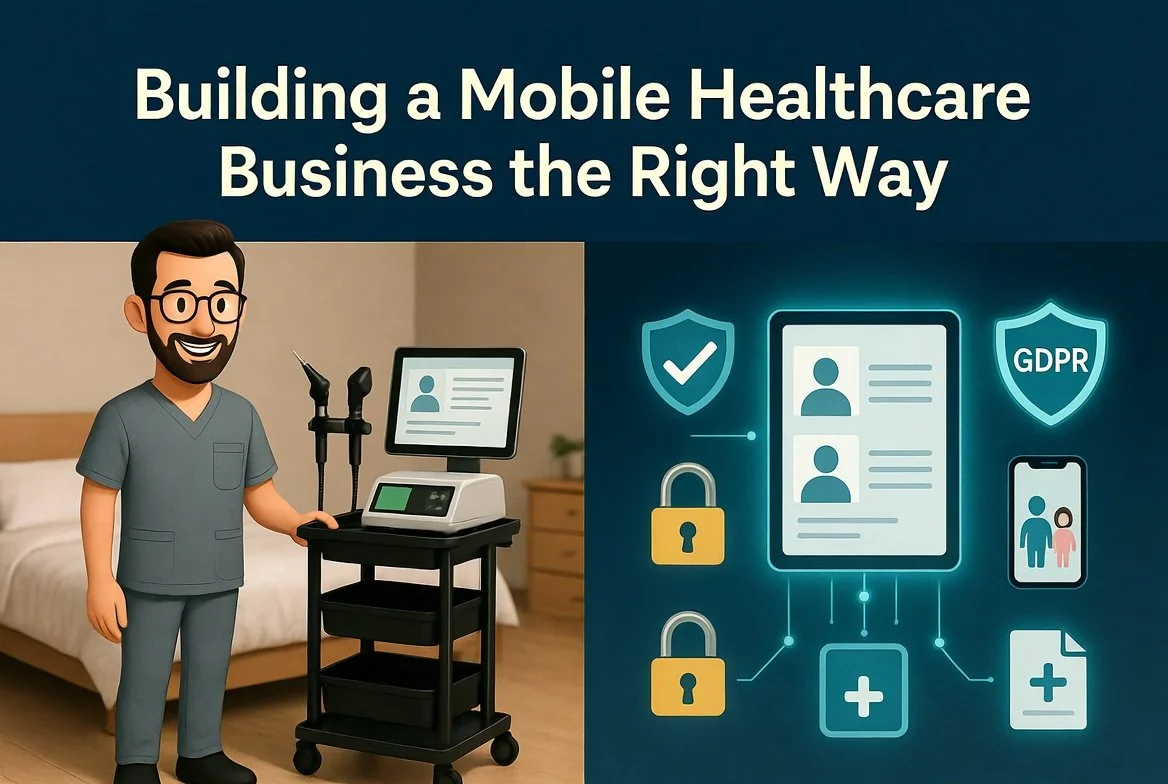
Building a Mobile Healthcare Business the Right Way
What the infrastructure actually looks like — by Jon Bishop, Clear Ear Cheer
I've spent the last year building a business that most people will never see inside.
Not the clinical work. Not the ear examinations, the microsuction, or the hearing aid servicing. The stuff underneath all of that. The governance. The systems. The digital infrastructure. The things that make the difference between a practitioner who turns up with a bag of equipment and one who can genuinely support a CQC-registered care home's compliance obligations.
I want to talk about that — because I think it matters, and because I don't think it gets talked about enough in independent healthcare.
After more than 20 years in telecommunications with Openreach, I'm launching Clear Ear Cheer in July 2026 — a mobile ear care service covering Essex and Suffolk. The motivation was personal. My mum struggled with hearing loss in residential care. The system couldn't reach her. I decided to build something that could.
But this isn't about the why. I've written about that elsewhere. This is about the how. Specifically — how do you build a mobile clinical service from scratch that a care home manager, a GP practice lead, or a CQC inspector can look at and immediately trust?
Start with the records
I use Zanda Health as my practice management platform. I want to give them a proper mention here because I've leaned heavily on not just the software but their Academy and support resources throughout this build — and that support has been genuinely valuable for an independent practitioner working without a clinical team around them.
Zanda isn't just a booking system for me. It's the backbone of my clinical governance. Every patient has a secure digital record. Every consultation is documented. Otoscopy findings, treatment delivered, referrals made — all recorded, timestamped, and stored in accordance with UK GDPR.
Here's the part I think is underappreciated: patients and their families can access their own records through the Zanda client portal. For a care home resident whose daughter lives in Birmingham and can't be present at every appointment, she can log in to see exactly what was found, what was done, and what was recommended. That transparency is something the NHS often struggles to deliver. I've built it into my service from day one.

GDPR isn't optional. Treat it that way.
I'm ICO registered. Consent is obtained, documented and stored for every patient. Data retention policies are in place. Privacy notices are published on my website and presented before first appointments.
I say this because CQC-registered care homes have a genuine obligation to ensure that every external provider they engage with that handles personal data has done so properly. I want that conversation to take about five minutes, not five weeks.
Patient education is part of the clinical service. Not an add-on.
I've built a substantial educational resource at clearearcheer.co.uk — condition information pages, a comprehensive FAQ, aftercare guidance, and blog content covering both clinical practice and the regulatory landscape of independent ear care.
This exists because I genuinely believe patients deserve to understand their ear health. A resident who knows why their hearing has been affected, what the procedure involves, and what to expect afterwards is a more confident and better supported patient. Their family members, reading the same resources from home, become partners in care rather than worried bystanders.
It also supports care homes directly. When a family member has a question at 9pm on a Sunday, the answer is already there.
AI — and I'm going to be straight about this
I use AI to support my clinical work. For research, for documentation, for building better resources. I think independent practitioners who dismiss these tools are leaving real capability on the table.
One specific application I'm integrating into my workflow is AI-powered SOAP note dictation at the point of care. Rather than sitting down after an appointment to write up clinical notes, I can narrate the findings and treatment in real time. AI automatically transcribes and structures it into a compliant clinical record.
The reason that matters isn't the efficiency gain. It's what happens to the time saved.
In a care home setting, an extra few minutes with a resident, unhurried, conversational, and human, is worth more than any administrative shortcut. For someone who may be anxious, or living with dementia, or simply not used to medical procedures, that calm, unhurried presence is part of the care. AI handles the paperwork. I focus on the person.
Voluntarily meeting standards nobody requires me to meet
CQC registration isn't legally required for independent mobile ear care practitioners — that's confirmed in writing from the CQC themselves (Reference: CAS-1218456-T5V7D1). I could operate without any of this infrastructure and be entirely within the law.
I chose not to. I'm registered with the Care Professionals Register and hold Care Professional Organisation Gold membership (formerly National Association of Care and Support Workers 💚💙) — both recognised by the Professional Standards Authority — and I have voluntarily built my entire practice to meet the CQC Fundamental Standards.
Not because a regulator requires it. Because the people I'm caring for deserve it. And because care home managers carry their own CQC obligations — they deserve a provider they can actually rely on.
What this looks like for a care home
When I walk into a care home in July, I'm not just bringing clinical skills and equipment. I'm bringing:
- Full digital clinical records accessible to residents, families and care teams
- GDPR-compliant data handling with ICO registration
- Documentation that integrates with existing care plans
- Educational resources that residents and families can access independently
- AI-supported clinical notes produced at the point of care
- Insurance certificates, DBS, CPR registration and CPO Gold credentials — all available on request
The clinical outcome matters. But so does everything around it.
I'm not writing this to fill appointment slots. I'm writing it because the standard of infrastructure in independent mobile healthcare matters — and I want to help raise it.
If you're a care home manager, a GP practice lead, or a pharmacy owner thinking about what specialist ear care support could look like for your setting, I'd genuinely welcome a conversation. And if you're an independent practitioner building something similar, I'd welcome that conversation too.
"Hear the Joy, Feel the Care"
Clear Ear Cheer — launching July 2026 across Essex & Suffolk
📞 07534 764560 | ✉️ jon@clearearcheer.co.uk | 🌐 www.clearearcheer.co.uk